You can read more about Grandmaster Su Kong Tai Djin, Grandmaster Ie Chang
Ming, and Grandmaster Sin Kwang Thé on our history page.
Masters
A Shaolin-Do student is considered a Master once he or she has
attained the rank of 5th Degree Black Belt or higher. Each rank also has a
title — 5th Degree Black Belts are referred to as Associate
Masters, 6th Degree Black Belts are Masters, 7th Degree Black Belts
are Senior Masters, and 8th Degree Black Belts and higher are Elder
Masters.
Many martial arts schools are lucky to have an instructor with a rank of 2nd
degree black belt or higher teaching classes. Here at the Sin Thé Karate
School, we have a plethora of masters and high ranking black belts to help the
students increase their skill sets. The following is not a complete list of
Masters in Shaolin-Do. However, it is a list of Masters who are active at the
Sin Thé Karate School.
Eldest Master Bill Leonard
10th Degree Black Belt, Head Instructor
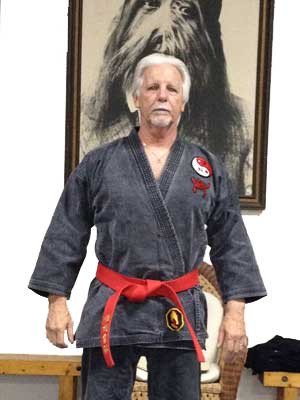
Eldest Master Bill Leonard is Grandmaster Sin Thé's most senior student, having
been with him since 1967 and was the first non-Chinese to ever attain the rank of
10th Degree Black Belt, having been promoted to that rank in March 2023.
Eldest Master Leonard is the head instructor at the Sin Thé Karate School and
brings his unparalleled 50+ years of teaching experience to the students there. He not
only teaches all ranks of students at the gym, but as a nationally respected instructor,
he is often sought out by Shaolin-Do students and masters from across the country for
private lessons. He has personally trained more than 10,000 students to the rank of
black belt, not to mention the countless other students who have trained under his
guidance over the years.
While known for his intense dedication, loyalty, and sense of honor, he is also known
as an incredible instructor. He is often the reason many students give for continuing
their studies in Shaolin-Do. He is regarded as the premier fighter in Shaolin-Do,
having won countless Shaolin-Do and open tournaments over the years.
His wife, Dale, who tragically passed away in 2017, was also 1st Degree Black Belt.
Eldest Master Leonard has five children and seven grandchildren.
8th Degree Black Belt — Elder Master

Ben Collins
Started in August 1989
Promoted in June 2023

Herman Collins
Started in September 1976
Promoted in June 2023

Tim Ray
Started in October 1974
Promoted in September 2019

Rick Reynolds
Started in January 1969
Promoted in June 2023
7th Degree Black Belt — Senior Master

Scott Frasure
Started in July 1976
Promoted in September 2011

Bev Razor
Started in March 1982
Promoted in September 2018

Bill Standafer
Started in November 1979
Promoted in September 2019
6th Degree Black Belt — Master

Bill Bivins
Started in March 1973
Promoted in March 2012

Rosie Bivins
Started in November 1976
Promoted in March 2012

Andra Collins
Promoted in May 2021

Don Enzweiler
Promoted in May 2021
5th Degree Black Belt — Associate Master

Mark Bongard
Promoted in September 2020

Barbara Elzey
Promoted in March 2017

Kelly Hunter
Promoted in March 2022
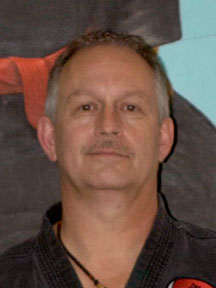
Lonnie McCoy
Promoted in September 2015

Cody Shackelford
Started in May 1991
Promoted in March 2009
Black Belts
Belts and sashes are used to distinguish between the external and internal
students. Our external students wear a traditional gi (uniform) and belt
while the internal students wear a sam (uniform) and a sash. While belts
and sashes are not equivalent, they are comparable in gauging the abilities and
progress of a student. Attaining the rank of a black belt or sash is by no
means the end of the journey in Shaolin-Do. Rather, it is just the beginning
— you are now considered a serious student and your real training begins.
Essentially, each rank of black belt or sash is at least equivalent to training
from white to black all over again!
Below is an incomplete (but growing) list of students
who have received their black belt or sash while studying with us.
4th Degree Black Belt

Lee
Fields

Robert
Newton

Reggie
Smith
3rd Degree Black Belt

Daniel
Carey
Dianne
Gray

Bahram
Kakavand
Matt
Kazlauskas

Claude
Meares

Steve
Pruitt

Shane
Schmidt

Remy
Simpson

Miles
Thomas

Chris
Wells
3rd Degree Black Sash

Cindy
Blood

David
Fannin
Christian
Kephart
2nd Degree Black Belt
Adi
Antoni

K.C.
Baker

Tiffiney
Baker
Liam
Barnes
Cindy
Blood
Tyler
Branham
Scott
Calhoun

Mila
Chitwood

Jenny
Corbin

Trey
Corbin
Wesley
Davis

Brian
Decker
Christa
Dowell

David
Duncan
Stephen
Dundon

Ian
Edwards
David
Fannin

Lisa
Fields

Terry
Filter
Ellen
Gould

Charles
Granville
Michael
Holmes

Will
Holmes

William
Holmes, Jr.

Meridith
Howes
Andrew
Jackson

Christopher
Jaynes

Ross
Leonard

Rob
Lutes

Mason
McCoy

Billy
Mullins

Will
Sloan

Joel
Stevenson

Joe
Walden

Scott
Walker
2nd Degree Black Sash

Kim
Blackburn
Rachel
Bongard

Erin
Mills
1st Degree Black Belt

John
Adaniel

Jun
Adaniel
Moshin
Ali

Courtney
Allison

Paul
Anaya

Jacob
Ang
John
Ang

Tiffany
Antoni

Andy
Armatorio

Aiden
Barnes
Austin
Barnes
William
Bencz
Kim
Blackburn

Alex
Bongard

Matt
Bongard
Braxton
Bosshart
Brett
Bosshart

Arwen
Careaga

Saul
Cervin
Elijah
Corbin
Taylor
Corbin
Porter
Corum
Bill
Davis
Rebecca
Davis

Richard
Dienst

Kayla
Duncan

Travis
Earlywine
Stephanie
Edelmann
Chuck
Emerich
Asher
Feddock

John
Gonterman
Caster
Grande
Pollux
Grande

Ulysses
Grande
Jasmine
Hall

Zach
Hamblen
Brad
Hammers
Lee
Hoffman

Anna
Holmes
Jonathan
Ingram
Nathan
Ingram
Fred
Karem
Eric
Kilten
Jeff
Leddy

Robert
Lee

Clay
Lefler

Doug
Lefler
Kelli
Lefler

Dale
Leonard

Bradley
Lutes

Crystal
Lutes
Kennan
Maxwell

Kevin
McCorkle
Stuart
Michael
David
Miles

Robbie
Moore
Lyle
Morgan
Sandy
Morgan
Dean
Morton
Nick
Mudd

David
Napier

Steve
Olshewsky
Kim
Otis
Mike
Painter

Lora
Popolizio

Tony
Prater

Adam
Reynolds

Todd
Reynolds

Hunter
Rulo
Tony
Sammons

Wade
Schwendeman
Amy
Sheikh

Aprill
Shepherd
John
Sikura
Tina
Skees

Sean
Smith
David
Sweet

Tim
Swerczek
Don
Tegt

Scott
Thompson

Anna
Thornton
Sean
Turner
Tommy
Wahudi

Brandon
White
Jarrod
Wilde
Eddie
Willett
Sherry
Wilson
Wayne D.
Wilson
Robert
Wood

Michael
Yusefzadeh

Will
Zibell
1st Degree Black Sash
Richard
Bartholomew
Jessica
Bedell

Meg
Daugherty
Michael
Flanagan

Patti
Hall
Linda
Horvay
Steve
Olshewsky
Diane
Spurlock
If you have received your black belt or sash with us and your name does not
appear on this list, or if your name or rank is incorrect, please contact the
Webmaster and we will either add
you to this list or correct your entry.