History

The Shaolin Temple was a Buddhist temple orginally built sometime between 386 and 534 A.D., but most agree that it was completed around 495 A.D. At its peak, the Shaolin Temple was one of the largest monestaries in all of China. A red brick wall enclosed rows of large halls and pagodas, as well as many smaller buildings. There were training halls, meditation halls, shrines, libraries, dormitories, and kitchens, as well as other buildings used for everyday life.
The Shaolin Temples were the equivalent of universities for the martial arts. Masters were professors, each of them a specialist in a particular area of training. Temples were known for a particular style, just like medical schools of today. Monks at each temple still practiced the forms from the other temples, but they specialized in the style for which their particular temple was known.
Over the course of time, an untold amount of martial knowledge was housed at the Shaolin temples. In order to better systemize this material, the techniques, motions and fighting applications of major systems were housed within eighteen forms; medium sized systems were housed within twelve forms; and smaller systems were housed within six or fewer forms.

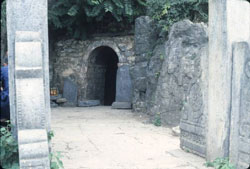
In the 6th century, Bodhidharma (also know as Ta Mo or Dharmo), an Indian prince on a pilgrimage from India crossed the Himilayan mountains on foot and eventually arrived in China. He attempted to take up residence in the Shaolin Temple, where he was not well received by the head abbot. At this point, Bodhidharma took refuge in a cave high atop nearby Song Mountain where he meditated for the next nine years. As the legend goes, several years into his meditation, Bodhidharma fell asleep. He was so disgusted with himself that he cut off his own eyelids and threw them away, vowing to never fall asleep during his meditations again. Hence the reason that all depictions of Bodhidharma show him with wide and wild eyes. At the conclusion of his meditation, the abbot repented and allowed Bodhidharma entrance to the temple.
What Bodhidharma found in the temple shocked him. The monks were in an emaciated state from only studying and praying all day. They were too frail and weak to stay awake during his rigorous meditation sessions. In order to build their strength and health, Bodhidharma developed a series of 49 exercises, which became known as I Chin Ching, the Change of the Muscle, Bone, and Senew. These exercises are similar to modern day yoga and would become the foundation for Shaolin martial arts.
The monks hated Bodhidharma and his exercises. Every morning they would hide from him and he would have to find them and drag them into the courtyard to practice, beating them with a stick, if necessary. And then one morning, Bodhidharma couldn't find the monks. They were not in any of their usual hiding spots. He looked everywhere before proceeding to the courtyard to practice himself, where he found all of them waiting. They had undergone a transformation, both physically and mentally. They had seen the benefits of getting in shape and had started to like it.
As time passed, the monks continued their practice of Bodhidharma's meditation techniques and his physical exercises. Naturally, as men and boys do, they began to have competitions about who could run faster, jump higher, or carry a large rock the furthest. This eventually escalated into physical tests between the monks themselves and then into play fighting. As more time passed, the monks saw the benefit in learning how to defend themselves and, being educated, began to study the natural fighters on the Earth... the animals!
During this period of Chinese history, the only members of society who were allowed an education were the royal family and the priesthood. The Shaolin monks decided to study the animals in a scientific fashion and to discover, document, and adapt to humans how each animal moved, attacked, and defended itself. Some groups of monks studied tigers, others observed all species of birds, and still others watched snakes, praying mantis, and monkeys. Slowly they began to adapt these movements to the human body and to pass on what they had learned to future generations. They created different series of movements called katas.

Because of their high level of spirituality, their extreme physical talents, and their education, becoming a Shaolin monk was a most desirable choice in life. Many parents sent their young sons to the temple in hopes of them attaining a better life by gaining admittance to the temple. However, it was not easy to become a student at the temple. The monks were very picky about who was admitted and often tested the potential students. Young boys stood at the gates for weeks, rain or shine, hoping to be selected. If they were chosen and permitted to enter the temple, they would be given chores for months before receiving any form of training. The smallest mistake could cost them everything they had worked for and they could be cast out at any time. Early training consisted of ruthless conditioning and endless stances. Once they were accepted as disciples and assigned to a master, the real training began. They received instruction in reading, writing, philosophy, and the martial arts.
The title of Grandmaster is bestowed upon the chosen leader of a martial arts system by the previous Grandmaster upon his death or retirement. Usually given to the highest ranking student, they are responsible for leading the entire system. There can only be one true and authentic Grandmaster of a martial arts system at any time.

Grandmaster Su Kong Tai Djin was born in the Fukien province of China in 1849 with a rare genetic condition which resulted in his entire body being covered with hair. His parents, convinced they had given birth to a demon, abandoned the infant into a nearby forest. A group of passing monks heard the baby's cries, and being educated, realized he was human, and brought him to the Shaolin Temple. Given the child's appearance, the monks knew he would not be adopted by any family and decided to raise the child themselves.
This situation was unique from all others because Su Kong Tai Djin was raised from birth in the temple. He was not only raised with the monks' ideals in mind, he was also not limited in his studies to one master. He was treated as everyone's favorite son and could study with anyone. The masters responded to his rare enthusiasm for learning and he quickly mastered hundreds of forms which had never been accomplished by one man before.
It is important to understand the distinction between the grandmaster of the temple and the head abbot. The grandmaster was in charge of the monks' physical progress and the mastery of the martial arts by the warrior monks. The head abbot was in charge of the temple as a whole and the monks' religious and intellectual studies.
After learning the temple was going to be attacked by the government, the monks evacuated the temple, taking with them priceless books, scrolls, and artwork and fled into the mountains after setting fire to the temple themselves. One of the young disciples who fled the temple with Su Kong Tai Djin was a young boy name Ie Chang Ming.
Su Kong Tai Djin died in 1928 at the age of 79.

Ie Chang Ming was born in 1880 and admitted to the Fukien temple as a young boy. There he spent all of his time and energy learning the martial arts, specifically the Golden Snake system. Upon the death of Su Kong Tai Djin, the title of Grandmaster was passed to his top student, Ie Chang Ming.
Later in his life, after taking a wife and starting a family, Grandmaster Ie returned home to find his wife being attacked by some soldiers. After killing ten of them, a price was put on his head. He fled to Bandung, Indonesia and eventually established a Shaolin school there. In Indonesian culture, the Chinese were hated. To avoid conflict with the government, Grandmaster Ie Chang Ming added the Japanese word, Do to Shaolin to disguise it as a Japanese art rather than a Chinese art. At this time, he also adopted the Japanese gi (uniform) and belt ranking system that we still use today in his honor.
Grandmaster Ie was famous throughout Indonesia for his martial arts abilities, specifically his iron palm training, his high level of meditation, and his mastery of the Golden Snake system, the highest art of the Shaolin Temple. To demonstrate his iron palm skills to his students, Grandmaster Ie placed several grains of uncooked rice between two boards and then smacked it with his hand. After lifting the top board, the rice had been reduced to powder! In another demonstration, he instructed one of his students to fetch a river rock from the stream near the school. He placed the rock on the anvil, struck it with his palm, and left the room. His students, unimpressed and failing to realize what they had just witnessed, walked over to the rock which was still sitting on the anvil and tried to pick it up. It simply turned to dust and fell through their fingers!
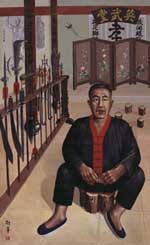
Grandmaster Ie's meditation skills were so high that he did not sleep at night. He would place his head on one chair and his heels on another chair and suspend himself between them every night while meditating for hours. In the morning, he would instruct one of his students to place a chopstick in the hollow of his throat and strike it with a rock. Rather than penetrate his throat, the chopstick would shatter into hundreds of splintered shards!
To demonstrate his mastery of the Golden Snake system, Grandmaster Ie would have his students tie his hands and feet together and then lay on the ground. At this point, a member of the audience would be brought forward, given a sharpened spear, and told to try and stab him. He was never stabbed! At this point, Grandmaster Ie would "slither" over to a large wooden pole and proceed to climb it without using his hands or feet which were still tied! He would wrap his body around the pole and, using his extreme muscular control, would slither up and around the pole to the top!
Ie Chang Ming died in 1976 at the age of 96.

In 1943, Sin Kwang Thé (pronounced Tay) was born in Bandung, Indonesia. His parents were Chinese but fled to Indonesia after the Communist Party came into power. Young Sin was drawn to the martial arts and actually began training in a lost art known as sandburn training at a very young age. In sandburn training, practitioners treat their hands with special medicine and then place them in buckets of heated sand. Over time, the sand is made hotter and the length of time one's hands are submerged is increased. This training toughens the hands but also makes the skin dangerous for other humans to touch, hence its attractiveness to martial artists. Sin Thé stopped the training after a sandburn master accidently picked up his grandchild without special gloves and the baby was killed. This master and all of his colleauges stopped teaching and all of their students were dismissed.
Not long after, a friend of the family and a close friend of Grandmaster Ie took young Sin Thé to his school to watch a class and be introduced. He was amazed by what he saw. Grandmaster Ie's students were practicing empty hand forms, weapon forms, and sparring. It was a far cry from being a student whose sole training was burning their hands! The seven-year-old asked to join, but was dismissed with polite excuses. After some time, he was allowed to join the school, and then the real tests began.
As it was at the Shaolin Temple, Grandmaster Ie was very strict in whom he admitted as a student. Potential students were studied from every conceivable angle to judge their temper, demeanor, and attitude. One wrong action would prevent a student from ever gaining admittance to the school. One night, Grandmaster Ie "tripped" and spilled a bowl of uncooked rice on the floor near Sin Thé. In Chinese culture, one way to diet is reduce your servings of rice by one grain each day. Grandmaster Ie instructed Sin Thé to find all 855 grains of rice that had been in the bowl. Late that night, long after all the students had left, he finally finished the task. In another test, Grandmaster Ie gave him a bowl filled with three different colors of beans and asked him to arrange them in triangles in the bowl, which from basic geometry, is impossible. It was a test of persistance and perseverance. In his final test, while Sin Thé watched a class, Grandmaster Ie poured a cup of hot tea over his head and looked directly into his eyes to gauge his reaction. Luckily for young Sin Thé, he was too shocked to be angry and was admitted into the school.

Just like at the temple, young Sin Thé's training began with stances. He would stand in horse stances, bow stances, and cat stances for hours at a time, especially while doing chores such as washing the dishes. To further build his leg strength, Grandmaster Ie required him to do one hundred one-legged squats every day! Eventually, after he had proven his trust in his teacher and built up his physical abilities, Sin Thé's instruction in Shaolin-Do began. At the age of thirteen, Sin tested for his black belt. This test was extremely difficult. At various times throughout his test, while performing his kata blindfolded, boards would be held in place to show that every punch and kick were properly executed. At the conclusion of the test, he had to spar seven other students while blindfolded!
As his training continued, Sin Thé's abilities increased greatly. He spent all of his time training with Grandmaster Ie and even stayed at his house on weekends and during his vactions from school. It was at this time that Grandmaster Ie saw Sin's potential and began grooming him to become the next grandmaster of Shaolin-Do. The pace of the training became frantic. Grandmaster Ie began teaching him one form every day of the week. But forms were not the only thing Sin was being taught. He was also being taught countless training exercises and forms of meditation, including Liu Fu Tao, or Sixth Sense training.
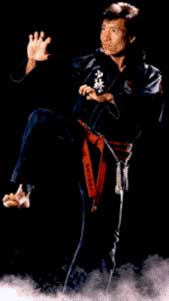
In 1964, Master Sin was preparing to leave for Berlin, Germany to study engineering and physics. But the breakout of a political crisis in Germany (the erection of the Berlin Wall) altered his plans. A friend of the family, who was a professor from the University of Kentucky, convinced Master Sin and his parents that he could get an equal education at a much cheaper cost. Master Sin flew to Cincinnati, Ohio, and took a taxi to Lexington, Kentucky, which cost him all of the money he had. Here he began his studies at Transylvania University and not long later began teaching Shaolin-Do (without his teacher's knowledge or permission) to suplement his income, the first time non-Chinese had ever learned the art of Shaolin-Do! Grandmaster Ie would later find out about his teaching and after some heartfelt correspondences, gave his student his blessing to teach Americans.
In 1968, his training was complete and Grandmaster Ie awarded Master Sin Thé the rank of 10th Degree Black Belt and the Grandmaster's Red Belt. Sin Kwang Thé had become the youngest Grandmaster in the history of the Shaolin martial arts! Grandmaster Sin Thé continued his education at the University of Kentucky and had nearly completed his Master's Degree in Nuclear Engineering when Ie Chang Ming died in 1976 at the age of 96. Grandmaster Sin realized that the world had plenty of engineers and scientists, but only one Shaolin Grandmaster. He quit his studies and devoted all of his time to teaching the art of Shaolin-Do.
You can visit Grandmaster Sin Thé's official website by clicking below.

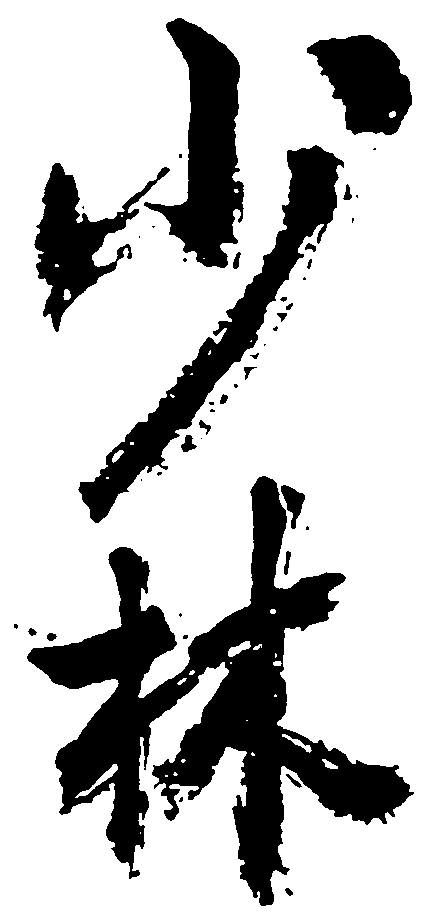
The Shaolin system as taught today is comprised of more than fifty styles and nine hundred forms. From this enormous body of material, today's Shaolin-Do practitioners receive a broad-based martial arts education that covers the entire spectrum of martial arts philosophy and technique. The Shaolin-Do curriculum teaches its practitioners sound fundamentals and provides each practitioner with the appropriate mental and physical challenge for their level of training.
Shaolin-Do is a traditional martial art, providing its practitioners with time-proven self defense techniques. Shaolin-Do strengthens the body and sharpens the mind, leading to a longer, more productive, and healthier life.
Shaolin-Do is the most complete and comprehensive martial arts system in the world. Shaolin-Do starts by introducing its students to basic Shaolin martial arts concepts. The material is organized so that beginning students have an opportunity to learn animal, empty hand, internal, and weapon techniques that are straightforward with readily apparent applications. The object is to build a solid base emphasizing proper technique, stance work, spirit, conditioning, and basic practical self-defense.
Upon completion of the lower belt and brown belt curriculum, the Shaolin-Do student has a minimum of 22 long forms through which they have studied a variety of techniques such as short katas, sparring techniques, self-defense, tiger, crane, bird, staff, nunchaku, broadsword, sai, and kwan tao (General Kwan's Knife). The student now has the conditioning, material knowledge, and sparring foundation to be considered a disciple, or serious beginner, and will continue to study a wide variety of styles and techniques that not only produce a well rounded martial artist, but also an extraordinarily well conditioned body and mind.